

This article has been translated using machine translation. Therfore, the content may contain inaccuracies or may not perfectly reflect the original meaning. For complete accuracy, please refer to the original version of the text. We appreciate your understanding.
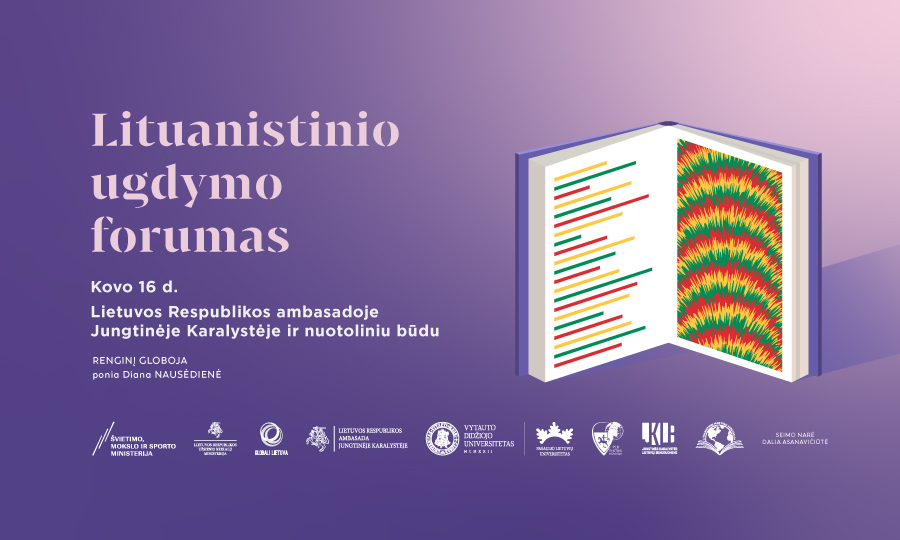
In mid-March, for the fifth year in a row, the Lithuanian Education Forum will take place, with the main focus this year being on ensuring sustainability and change in Lithuanian schools. The event will take place on 16th March, at the Embassy of the Republic of Lithuania in London and remotely.
Since 2021, four Lithuanian Education Forums have been held to draw the attention of the Lithuanian public and the diaspora to the importance of Lithuanian education in foreign countries. The first forum focused on the realities of Lithuanian language schools, the need for adequate attention and support for schools, the strengthening of Lithuanian identity and the benefits of bilingualism. A strategic document, the Forum Declaration, was published, outlining the guidelines for the development of Lithuanian education.
The second forum explored the psychological reasons for the (in)transmission of the Lithuanian language and the different conditions for the language to flourish in mixed and Lithuanian families. The third forum reflected the changed situation of Lithuanian language schools after consistent state funding was secured - the discussion focused on Lithuanian language schools as strong, interesting, high-quality and relevant. The fourth forum focused on highlighting the strengths of Lithuanian language schools. To summarise the changes that have taken place in the field of Lithuanian education since 2021, the Forum published the “Guidelines for the Sustainability, Strengthening and Development of Informal Lithuanian Education Abroad”.
We are stronger, but is that enough?
This is the question posed by Donata Simonaitienė, the President of the Association of Lithuanian Language Schools and the head of a Lithuanian language school in Cavan, Ireland, which has been operating for 17 years.
"In the last 4 years we have been gaining more and more stability, but in order to make the school more attractive, we need to look for other ways of understanding the language, other ways of approaching the child. The number of children attending school is growing very slowly, which means we need to take different measures. Although we are stronger now, sustainability and continuity are at stake," says D. Simonaitienė.
This year's event is more interested in hearing from the outside world than previous forums, so the programme is open to academics, researchers of the Lithuanian language, representatives of professional clubs, and current and former students of Lithuanian language schools.
"We don't need to be constantly praised. It is more important to hear what we still need to do. What are the aspects that we don't see, don't realise? Maybe there is a necessary element in our lessons that we have not thought about yet. We are open to a new approach that will help us grow", says D. Simonaitienė.
Changes in Lithuanian language schools - a necessity and a guarantee of success
The last five years in the history of Lithuanian language education can safely be called a breakthrough year. Since 2021, the National Education Agreement has enshrined Lithuanian education as part of the general education system; since 2023, for the first time, permanent financial support for Lithuanian schools from the state budget has been established; annual campaigns to promote and publicise Lithuanian education have been organised; and since 10 August 2024, Lithuanian School Day has been officially celebrated.
According to Lithuanian Vice-Minister of Foreign Affairs Julius Pranevičius, Lithuanian language education is a strong bridge between different generations of the diaspora and Lithuania, and an integral part of our national identity.
"Lithuanian language schools around the world not only educate the youth of the diaspora, but also strengthen Lithuanian communities and ensure the continuity of Lithuanian language and culture. It is important that this bridge not only maintains communication, but also helps diaspora youth to return or come to Lithuania to study, to intern, to create their own businesses and new homes. It is our duty to provide Lithuanian language schools with the necessary support and create the most favourable conditions for their activities and development," said the Vice-Minister of Foreign Affairs.
However, in addition to such favourable external changes, the success of Lithuanian language schools requires constant changes within the schools.
"There is a huge difference in the way Lithuanian language was taught in the main Lithuanian emigration countries in Europe after Lithuania's accession to the European Union in 2008, 2014 and now, because children in the diaspora are changing. At the beginning, we worked with children who came here still knowing how to speak Lithuanian. Later on, those who could speak only part of the language came to school, and now those who were born abroad have grown up. Let's not forget the second generation of children who will start attending Lithuanian language schools in the near future, which will again be a new challenge," said Alvija Černiauskaitė, the Chair of the Education Commission of the World Lithuanian Community.
According to Donata Simonaitienė, who has been working in the field of Lithuanian language education for almost 20 years, when talking about the necessary changes in Lithuanian language schools, we need to keep in mind not only the pace of global change, but also the challenge of schools not to remain separate “islands”: "We have to reinvent ourselves so often and transform ourselves so often that sometimes it seems that you don't even know how to transform. We really need constant positive change because we are still isolated in our own countries, in our own bubbles of schools.
Principles for teaching an easily understandable language
A recent innovation in language learning - the teaching of simple or easy-to-understand language - is making its way not only in Lithuania but also in Lithuanian education. According to Dr Laura Vilkaitė-Lozdienė, one of the speakers of the forthcoming forum, more and more texts written in easy-to-understand language are appearing in Lithuania. "Simpler vocabulary, shorter sentences and, most importantly, a clear and purified message make such texts easier to understand for both language learners and cognitively challenged readers. For pupils of Lithuanian language schools, texts written in an easy-to-understand language can be a way to experience success in reading texts that are relevant and of interest to them," the linguist shared her experience.
According to Vilma Leonavičienė, Head of the Lithuanian Studies Centre at Vytautas Magnus University (VMU), the reason why this topic appears in the Forum programme is that such innovations in language teaching are bound to reach schools. “This method is already used in Scandinavia, but it is not well known in our country yet, which is why we will be discussing how language and language learning are changing and how even in Lithuania there is a growing need for different ways to teach,” V. Leonavičienė said.
D. Simonaitienė, the chair of the Association of Lithuanian Language Schools, also emphasises the need for Lithuanian schools to turn to academic language research: ‘If we are talking about the sustainability of Lithuanian schools, if we want to attract more parents and children, Lithuanian schools need to keep pace with academic research and look at language policy differently’.
The organisers of the Forum invite you to discuss these topics on 16 March. The forum will take place at the Embassy of the Republic of Lithuania in London on 16 March, and remotely.
The Forum is organised by the Ministry of Education, Science and Sport, the Ministry of Foreign Affairs, Vytautas Magnus University, the Embassy of the Republic of Lithuania in the United Kingdom, the Education Commission of the World Lithuanian Community, the Association of Lithuanian Language Schools, the Lithuanian Community of the United Kingdom, and the Member of the Parliament Dalia Asanavičiūtė.
The forum is under the patronage of Mrs. Diana Nausėdienė.